



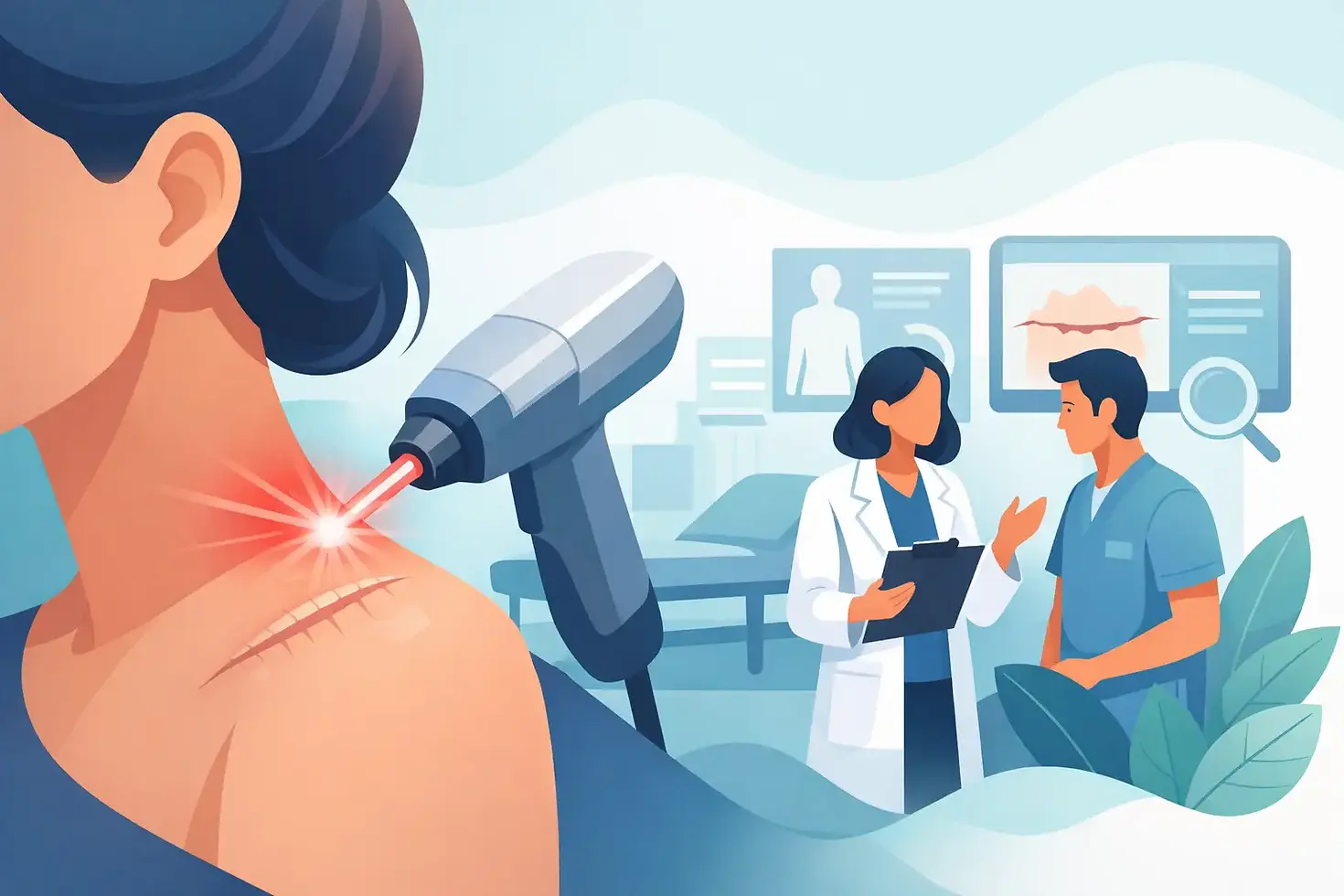
Laser Scar Treatment and Specialist Care
A scar may be medically healed yet remain raised, red, tight, indented or distressingly visible. Laser scar treatment is not a single procedure or a cosmetic shortcut. It is a specialist-led process of identifying how a scar behaves, what has caused it and which laser energy, if any, can improve its appearance, symptoms or function without creating further injury.
For patients with acne scarring, burns, traumatic wounds, caesarean scars or marks after surgery, the correct treatment plan can make a meaningful difference. The wrong plan, however, can lead to prolonged redness, pigment change, delayed healing or disappointment. This is why scars require a more considered approach than a standard aesthetic treatment menu.
What laser scar treatment can address
Lasers work by delivering carefully controlled energy into selected components of the skin. Depending on the device and settings, that energy may target blood vessels, pigment, water within the tissue, or the dense collagen that makes a scar feel thick and inflexible. The aim is not to erase a scar completely. No ethical specialist should promise that. The aim is to make it less noticeable, less symptomatic and, where relevant, less restrictive.
A vascular laser may reduce persistent redness in an immature scar. Fractional resurfacing lasers can create microscopic treatment channels in the skin, encouraging remodelling of collagen and helping to soften uneven texture. For a raised, firm or contracted scar, particularly after a burn, an ablative fractional laser may improve pliability and movement as well as appearance. Different laser systems can also have a role in selected pigmented scars, although this requires caution, particularly in darker skin types.
The best result is often achieved by treating the scar characteristic that matters most. A pale but tethered surgical scar needs a different approach from an active red acne scar, while an indented rolling acne scar may also need subcision, surgical release or carefully selected volumisation. Laser treatment is powerful, but it is not a replacement for accurate diagnosis.
Why scar type and timing matter
Scars change over time. In the early months, they may be red, swollen, itchy and sensitive. Many then mature gradually, becoming flatter and paler over 12 to 18 months. Some do not follow this expected course. Hypertrophic scars remain raised within the original wound boundary, while keloid scars extend beyond it and can recur after injury. Burn scars may contract and limit movement across a joint, the neck, eyelids or mouth.
Treatment timing is therefore individual. It is no longer always necessary to wait until a scar is fully mature before considering laser care. Early treatment can be appropriate in selected cases, particularly where redness, itch or progressive thickening is affecting recovery. Yet a newly healed wound may also be too fragile for certain procedures. The decision depends on healing quality, scar activity, skin type, medical history and the treatment objective.
For acne scars, active acne should be brought under control before significant resurfacing is undertaken. Treating inflamed breakouts without addressing the underlying disease risks generating new scars while older ones are being treated. For post-surgical scars, the operating surgeon’s records, the location of the incision and any history of wound complications can all influence the plan.
The features assessed at consultation
A proper scar consultation examines more than a photograph. The specialist considers scar thickness, colour, vascularity, sensitivity, adherence to deeper tissues and the way it affects facial expression or movement. They will also assess the surrounding skin, previous treatments, tendency to pigmentation, sun exposure, medications and any history of abnormal scarring.
This assessment is especially significant for patients with richly pigmented skin. Post-inflammatory hyperpigmentation and, less commonly, loss of pigment are recognised risks after energy-based treatment. These risks can often be reduced through device selection, conservative settings, skin preparation and disciplined aftercare, but they should be discussed openly rather than minimised.
Which lasers may be used for scars?
The term “laser treatment” can conceal important differences. The appropriate technology is selected according to the scar, not according to what is most widely advertised.
Pulsed dye and other vascular lasers are commonly used for red, vascular scars. By targeting blood vessels, they can reduce redness and may help symptoms such as itch or tenderness. They are often useful as part of early scar management, though several sessions may be required.
Non-ablative fractional lasers deliver energy beneath the skin surface while leaving more of the outer layer intact. Recovery is generally shorter than with ablative resurfacing, but improvement may be more gradual. They can be useful for textural irregularity and selected acne scars.
Ablative fractional carbon dioxide or erbium lasers remove microscopic columns of tissue and stimulate more substantial remodelling. They can be highly effective for deep textural change, raised scars and burn scar stiffness, but they involve greater downtime and require experienced judgement. Oozing, crusting and redness are expected during early healing, and meticulous post-treatment care is essential.
No device is inherently “best” in every circumstance. A laser that is excellent for red scars may do little for a deep tethered depression. A strong resurfacing treatment may be unsuitable for someone unable to avoid sun exposure during recovery. Specialist care means making these trade-offs explicit.
Laser treatment is often one part of a wider plan
Complex scars rarely respond optimally to a single modality. Silicone therapy, pressure garments, steroid injection, scar massage, surgical revision, subcision, microneedling or fat grafting may be considered alongside laser procedures. In a scar that crosses a mobile area, releasing a contracture surgically may be necessary before laser remodelling can improve the surface and flexibility.
This is where consultant plastic surgical expertise matters. A clinician trained in both reconstructive surgery and therapeutic laser practice can assess whether a scar is fundamentally a surface problem, a structural problem or both. That distinction protects patients from repeated treatments that improve neither function nor confidence.
At Skin Surgeon, treatment planning is consultant-led, with the option to combine advanced laser care with surgical scar management where clinically appropriate. This is particularly relevant for patients with burn scars, difficult post-operative scars and scars that have not responded as expected elsewhere.
What recovery and results realistically involve
Recovery varies markedly by treatment. A vascular laser may leave temporary redness or bruising, whereas ablative fractional resurfacing can involve several days of weeping and crusting followed by weeks of residual pinkness. Strict sun protection is not optional: ultraviolet exposure can worsen pigmentation and compromise the cosmetic result.
Patients are usually advised to use bland prescribed skincare, avoid picking or exfoliating treated areas, and follow clear instructions on cleansing, make-up, exercise and sun avoidance. Where the skin barrier has been disrupted, infection is uncommon but possible. Patients with a history of cold sores may require preventative antiviral medication before facial resurfacing.
Results emerge gradually because collagen remodelling takes time. Some changes in redness or texture may be seen within weeks, but meaningful improvement commonly develops over several months. Most scars need a course of treatment rather than one session. The number and spacing of sessions should be based on clinical response, not a pre-packaged promise.
Choosing a specialist for laser scar treatment
Laser devices can be operated in many settings, but scar treatment carries a different level of responsibility from routine cosmetic procedures. Inappropriately high energy, poor patient selection or failure to recognise a hypertrophic scar, keloid tendency or contracture can worsen the very concern a patient wishes to improve.
Look for direct consultant involvement, formal training in laser surgery and a clear understanding of reconstructive as well as aesthetic scar care. Ask what type of laser is proposed, why it suits the particular scar, what alternatives exist and what outcome is realistic. A credible consultation should include risks, downtime and the possibility that surgery or another treatment may be more appropriate.
A scar often carries a history that is far more significant than its size. The right starting point is a careful specialist assessment that respects both the biology of the scar and the person living with it.


Comments