



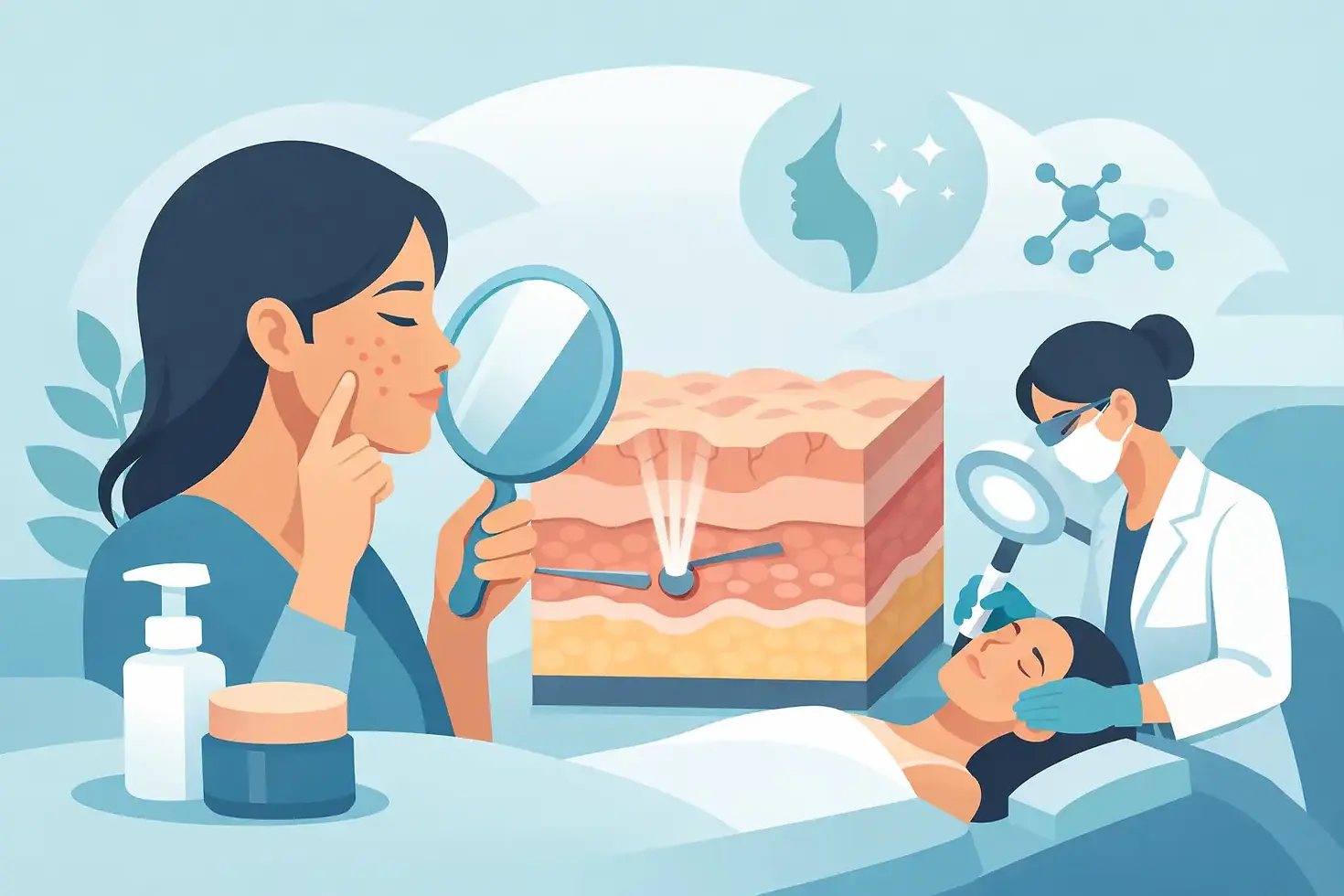
How to Improve Acne Scarring with Specialist Care
Acne may settle, but the changes it leaves in the skin can remain highly visible in certain lighting, under make-up, or at close range. Understanding how to improve acne scarring starts with an accurate diagnosis: scars are not all the same, and a treatment that improves one type may have little effect on another. The most dependable results come from a consultant-led plan that addresses the structure of each scar, your skin type, ongoing acne activity, and the time available for recovery.
Why acne scars need an individual treatment plan
Acne scarring develops when inflammation damages collagen during the healing process. Some areas heal with too little collagen, leaving depressions in the skin. Others produce excess collagen, creating raised scars. Redness or brown discolouration after acne can also look like scarring, although it is often a mark of inflammation or pigment change rather than a permanent textural scar.
This distinction matters. Treating post-inflammatory redness with a vascular laser is very different from releasing a tethered rolling scar beneath the skin. Likewise, a resurfacing treatment may soften shallow textural irregularity but cannot reliably correct a deep, narrow ice-pick scar on its own.
A proper consultation should examine the face at different angles and assess scar depth, distribution, skin tone, prior treatments, medical history and the risk of pigmentary change. Active acne should usually be controlled before intensive scar treatment begins. Continuing inflammatory breakouts can create new scars while treatment is underway.
How to improve acne scarring by scar type
Most patients have a combination of scar types. This is why a single treatment is seldom the whole answer.
Rolling scars
Rolling scars create broad, undulating depressions. They are frequently tethered to deeper tissue by fibrous bands. Subcision is often considered where tethering is a significant feature. Using a specialised instrument, the clinician carefully releases these attachments beneath the skin, allowing the surface to lift over time as healing occurs.
Subcision may be combined with carefully selected filler in appropriate cases, or followed by laser resurfacing to improve the remaining surface texture. Bruising and swelling can occur, and treatment must be performed with a detailed understanding of facial anatomy.
Boxcar scars
Boxcar scars are wider depressions with more defined edges. Shallow boxcar scars may respond well to fractional laser resurfacing, which creates controlled microscopic treatment zones and stimulates collagen remodelling. Deeper scars may require a combination approach, such as subcision, focal scar treatment, punch elevation or surgical revision.
The choice depends on the depth of the scar and its relationship to the surrounding skin. Treating every scar with the same laser setting is neither precise nor appropriate.
Ice-pick scars
Ice-pick scars are narrow and deep, often extending well below the level that resurfacing devices can effectively reach. Focal chemical reconstruction techniques, commonly known as TCA CROSS, may improve selected scars by placing a high-strength chemical precisely within the scar. Some scars are better suited to punch excision, a small surgical procedure in which the scar is removed and the area is carefully repaired.
These treatments require meticulous technique. Over-treatment can increase the risk of prolonged redness, pigment change or a wider scar, particularly in skin that is prone to post-inflammatory hyperpigmentation.
Raised scars and persistent redness
Hypertrophic scars are raised but remain within the original area of injury. They differ from depressed acne scars and may require treatments that reduce scar thickness and vascularity, such as vascular laser therapy, steroid injections, silicone-based scar management or, in selected cases, surgical revision.
Persistent red marks after acne may improve with time, sun protection and treatment directed at blood vessels. Brown marks may respond to pigment-focused skincare and carefully chosen energy-based treatment. Neither should be confused with an indentation in the skin, although both can make acne scarring appear more pronounced.
The role of laser treatment for acne scars
Ablative fractional lasers, including carbon dioxide and erbium-based systems, can be highly effective for textural acne scarring when selected and performed appropriately. They remove microscopic columns of damaged tissue while preserving untreated skin between treatment zones, supporting healing and collagen remodelling.
Their benefits must be balanced against downtime and risk. Redness, swelling, crusting and temporary darkening are expected parts of recovery for many patients. More intensive settings may offer greater improvement in one session, but they also require more recovery and may carry a higher risk of complications. The right approach is not always the strongest treatment.
Non-ablative fractional devices and radiofrequency microneedling can offer a lower-downtime route for certain patients, particularly where the scars are milder or where a more gradual course is preferred. Their improvement may be less dramatic per session, and multiple treatments are often required. A specialist should explain these trade-offs clearly rather than presenting any device as universally superior.
For patients with darker skin tones or a history of pigment change, treatment settings, pre-treatment skincare and aftercare need particular care. Safety depends not only on the technology but on clinical judgement, conservative planning and close review throughout the treatment journey.
What skincare can and cannot do
Skincare is valuable, but it has limits. Daily broad-spectrum sun protection helps reduce contrast between scars and surrounding skin, limits pigment change, and protects collagen. Prescription retinoids may support cell turnover and collagen production in suitable patients, while azelaic acid and other targeted products can assist with acne control and uneven pigmentation.
However, topical products do not release tethered scars, remove deep ice-pick scars or replace lost volume. Be cautious of claims that a cream can erase established acne scars. Strong home acids, aggressive scrubs and unregulated chemical peels can irritate the skin, worsen inflammation and increase the chance of pigmentation problems.
If a prescription retinoid or active treatment is being used, it may need to be paused before certain procedures. This should be decided by the treating clinician, not by guesswork.
Why combination treatment often gives better results
The best results are usually built in stages. A patient may first need acne control and pigment stabilisation. Tethered scars can then be released with subcision, deep focal scars treated individually, and overall texture refined with a fractional laser. The order matters because each treatment prepares the skin for the next step.
Improvement is generally progressive rather than immediate. Collagen remodelling continues for months after a procedure, and many patients require more than one session. The aim is meaningful improvement in texture, shadowing and confidence, not an unrealistic promise of poreless or completely unmarked skin.
Photographs taken in standardised lighting are helpful in tracking progress. They offer a more honest comparison than day-to-day mirror checks, which can be heavily affected by light, hydration, make-up and skin redness after treatment.
Choosing the right clinician for acne scar treatment
Acne scar treatment sits at the intersection of skin surgery, laser expertise and aesthetic judgement. Procedures such as subcision, punch techniques and ablative laser resurfacing require an understanding of scar biology, wound healing, facial anatomy and complication management.
Ask who will assess you, who will perform the procedure, and what their training is in laser and scar surgery. A high-quality consultation should include an explanation of alternatives, expected recovery, likely number of sessions, costs across a treatment course, and the potential risks for your individual skin.
At Skin Surgeon, acne scar treatment is planned within a consultant-led reconstructive and laser practice, with the option to combine surgical and non-surgical techniques where clinically appropriate. This is particularly valuable for complex, mixed or previously treated scars.
Preparing for treatment and protecting your result
Before treatment, avoid tanning and disclose all medication, previous isotretinoin use, cold sore history and any tendency to develop raised scars or dark marks after injury. Follow pre-treatment instructions exactly, particularly where antiviral medication, pigment-suppressing skincare or a period without active products has been advised.
After treatment, gentle cleansing, prescribed wound care, moisturising and strict sun avoidance support predictable healing. Do not pick crusting or attempt to accelerate recovery with exfoliants. Contact your clinical team promptly if pain increases significantly, spreading redness develops, or you are concerned about infection.
Acne scars are often emotionally significant because they represent a condition that may already have taken years to control. A measured plan, led by the right expertise, can improve the skin without asking it to heal faster than biology allows.


Comments