


How Laser Scar Revision Works
A scar that looks settled on the surface can still be biologically active underneath. That is why understanding how laser scar revision works matters. The goal is not simply to polish the skin, but to influence scar tissue at a structural level so that thickness, colour, texture, tightness and visibility can improve in a controlled medical setting.
Scar revision with laser treatment is often misunderstood as a single, cosmetic procedure. In reality, it is a specialist process that depends on scar type, skin type, body area, the age of the scar, and whether there are symptoms such as itching, pain or contracture. In experienced hands, laser treatment can form part of a broader reconstructive plan rather than a standalone aesthetic intervention.
How laser scar revision works in the skin
A scar forms when the skin repairs itself after surgery, trauma, burns, acne or inflammation. Unlike normal skin, scar tissue is organised differently. Collagen fibres are often laid down in a more chaotic pattern, blood vessels may remain more visible, and the skin can become either raised, thickened, tethered, pale, red, or uneven in texture.
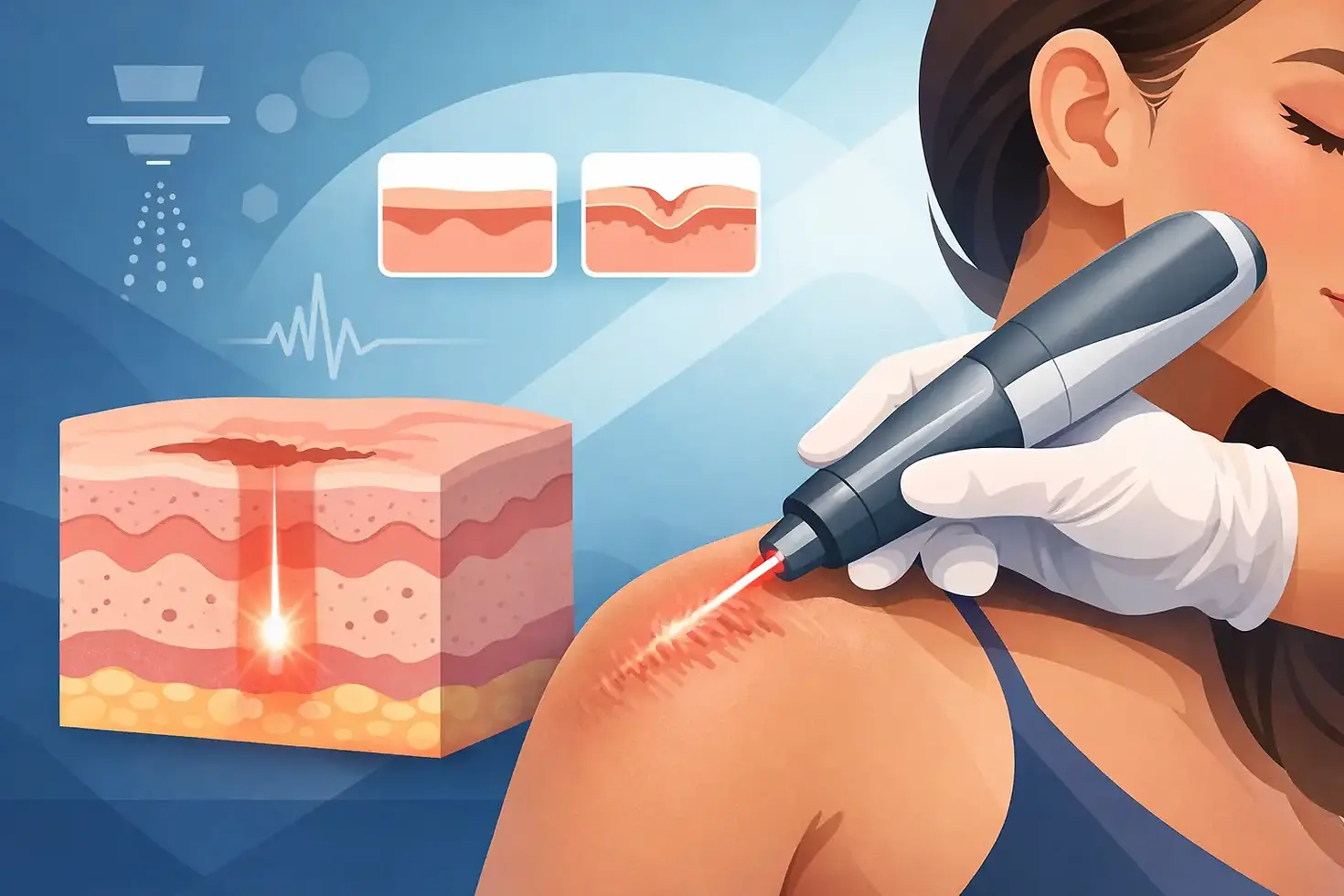
Laser scar revision works by delivering carefully selected wavelengths of light into the scar and surrounding skin. That energy is absorbed at specific targets within the tissue, most commonly water, pigment or blood vessels. Once absorbed, the laser creates a controlled thermal effect. This is the key principle - deliberate, precise injury that stimulates a more orderly healing response.
Depending on the device and settings used, the laser may reduce excess vascularity in a red scar, break down abnormal pigment, soften dense collagen, stimulate collagen remodelling, or create microscopic channels that trigger tissue renewal. The skin then repairs itself over the following weeks and months in a way that can make the scar flatter, softer and less conspicuous.
This is not an instant erasure. Scars cannot usually be removed completely. What can often be achieved is meaningful improvement in quality, function and appearance.
Which lasers are used for scar revision?
There is no single best laser for every scar. Different technologies address different scar behaviours, and complex scars may require staged treatment.
Vascular lasers are commonly used for red or inflamed scars because they target haemoglobin within blood vessels. By reducing abnormal vascularity, these treatments may help settle persistent redness and, in some cases, improve symptoms such as itching.
Fractional ablative lasers work differently. They create microscopic columns of controlled injury in the skin while leaving surrounding tissue intact. This fractional pattern helps the skin heal more efficiently and can improve texture, thickness and stiffness. These lasers are often used for surgical scars, acne scars, traumatic scars and certain burn scars.
Non-ablative fractional lasers can also stimulate remodelling with less surface disruption, although they may be more modest in effect. They can be useful where downtime needs to be limited or where skin characteristics make a gentler approach preferable.
In some patients, pigment-specific treatments or combination approaches may be considered. The correct choice depends on diagnosis, not fashion. A consultant-led assessment is important because a raised scar, a keloid tendency, a mature white scar and a post-burn contracture are not variations of the same problem. They are different clinical entities.
How laser scar revision works for different scar types
The phrase how laser scar revision works sounds straightforward, but the answer changes according to the scar itself.
For red, immature scars, treatment often focuses on blood vessels and inflammation. The aim is to reduce erythema and potentially interrupt signals that keep the scar active. These scars may respond earlier in their development, and timing can matter.
For thick or raised scars, the challenge is excess collagen and tissue bulk. Fractional ablative laser treatment can help break up stiffness and encourage remodelling. If the scar is also functionally tight, for example after burns or surgery across a joint, the treatment plan may be designed as much around movement and comfort as appearance.
For indented or atrophic scars, such as certain acne scars, the laser creates controlled micro-injury that stimulates collagen production and textural improvement. Results tend to be gradual because collagen remodelling takes time.
For darker scars or scars with pigment irregularity, treatment becomes more nuanced. Pigment can worsen if the wrong settings are used, especially in darker skin types. This is one reason specialist laser knowledge matters. The question is not only whether a laser can be used, but which device, at what energy, and with what preparation and aftercare.
What happens during treatment?
Treatment begins with assessment, not the laser itself. The scar is examined for maturity, thickness, colour, contour, symptoms, previous treatments and anatomical location. Skin type is also critical because it affects both safety and laser choice.
During the procedure, the skin is cleansed and, depending on the laser and treatment depth, a topical anaesthetic or other pain control may be used. Protective eyewear is worn. The laser is then passed over the scar using settings tailored to the treatment objective.
Some patients describe the sensation as heat, snapping or prickling. The intensity varies with the device used. A vascular laser session can be relatively brief and well tolerated, whereas a deeper fractional ablative treatment is more involved and usually carries more downtime.
Immediately afterwards, the scar may look red, swollen or slightly bronzed. With fractional treatments, there may be crusting or a fine grid-like appearance for several days. This is expected healing, provided the skin is monitored and cared for properly.
How many sessions are needed?
Most scars require a course of treatment rather than a single session. The exact number depends on the scar type, treatment goals and response. Some scars improve noticeably after one or two sessions, while others need a staged programme over several months.
It also depends on what success looks like for that patient. Reducing a visible post-surgical scar on the face is a different objective from improving a burn scar that restricts movement or a Caesarean scar that remains tethered and uncomfortable. In specialist practice, outcomes are judged both cosmetically and functionally.
Patience is important. Laser treatment initiates change, but the remodelling process continues well beyond the appointment itself. Collagen turnover and vascular settling take time.
What are the limits and risks?
Laser scar revision is effective, but it has limits. It cannot restore scar tissue into untouched skin. It may not be the right first treatment for every scar, and some scars respond better than others.
There are also genuine risks. These include prolonged redness, post-inflammatory hyperpigmentation, hypopigmentation, delayed healing, infection, flare of sensitive skin conditions and, rarely, worsening of the scar. Inappropriately aggressive treatment can do harm, particularly in patients with darker skin types, recent sun exposure, active acne, a history of poor healing or a tendency to keloid scarring.
This is where the distinction between a specialist surgical laser practice and a general aesthetic provider becomes important. Scar revision is not simply about operating a machine. It requires judgement about diagnosis, laser physics, wound healing, skin biology and reconstructive planning. In more difficult cases, treatment may need to be combined with steroid therapy, surgery, silicone therapy or other modalities rather than relying on laser alone.
Who is a good candidate?
Many patients are suitable candidates, but not all at the same time point. Some scars benefit from early intervention once the skin has healed sufficiently, especially if they are red and active. Others should be allowed to mature further before treatment. An accurate assessment helps determine when to intervene and when to wait.
Good candidates are usually those with realistic expectations, a clear diagnosis and a treatment plan matched to the scar rather than to a generic package. Patients with burns, post-operative scars, traumatic scars and acne scarring may all benefit, but each requires a different level of planning.
At consultant level, the question is not only can this scar be treated, but what is the safest and most effective pathway for this particular patient.
Why specialist assessment matters
Laser treatment for scars sits at the intersection of aesthetics and reconstruction. That is precisely why experience matters so much. A visible scar on the cheek, a hypertrophic sternotomy scar, a burn scar across the neck and a post-cancer reconstructive scar all demand different judgement.
At Skin Surgeon, consultant-led laser care is grounded in plastic surgery principles as well as advanced laser expertise. That matters when the aim is not simply surface improvement, but careful treatment of tissue that may be medically, functionally and psychologically significant.
The best scar treatment plans are rarely generic. They are built around anatomy, healing behaviour, skin type, symptom burden and long-term outcome. For patients seeking high-level care, that level of precision is often the difference between a standard treatment and a genuinely thoughtful one.
If you are considering scar treatment, the most useful starting point is a specialist opinion that explains what can be improved, what cannot, and which approach makes clinical sense for your skin and your scar.


Comments