


How to Treat Tethered Scars with Specialist Care
A scar that appears to pull inward when you raise an arm, smile, bend, or stand upright is not simply a cosmetic concern. It may be tethered to the deeper tissues beneath the skin, causing a visible indentation, tightness, discomfort or restricted movement. Understanding how to treat tethered scars starts with identifying exactly what is being pulled, how deeply the scar is fixed, and whether the priority is function, appearance, or both.
Tethered scars can follow surgery, trauma, burns, infection, acne, caesarean delivery and other wounds that heal with fibrosis. They are often particularly distressing because the surface may look relatively small while the effect on movement or contour is substantial. Treatment should therefore be planned by a specialist who can assess the skin, subcutaneous tissue, muscle and surrounding structures, rather than treating the surface scar alone.
What makes a scar tethered?
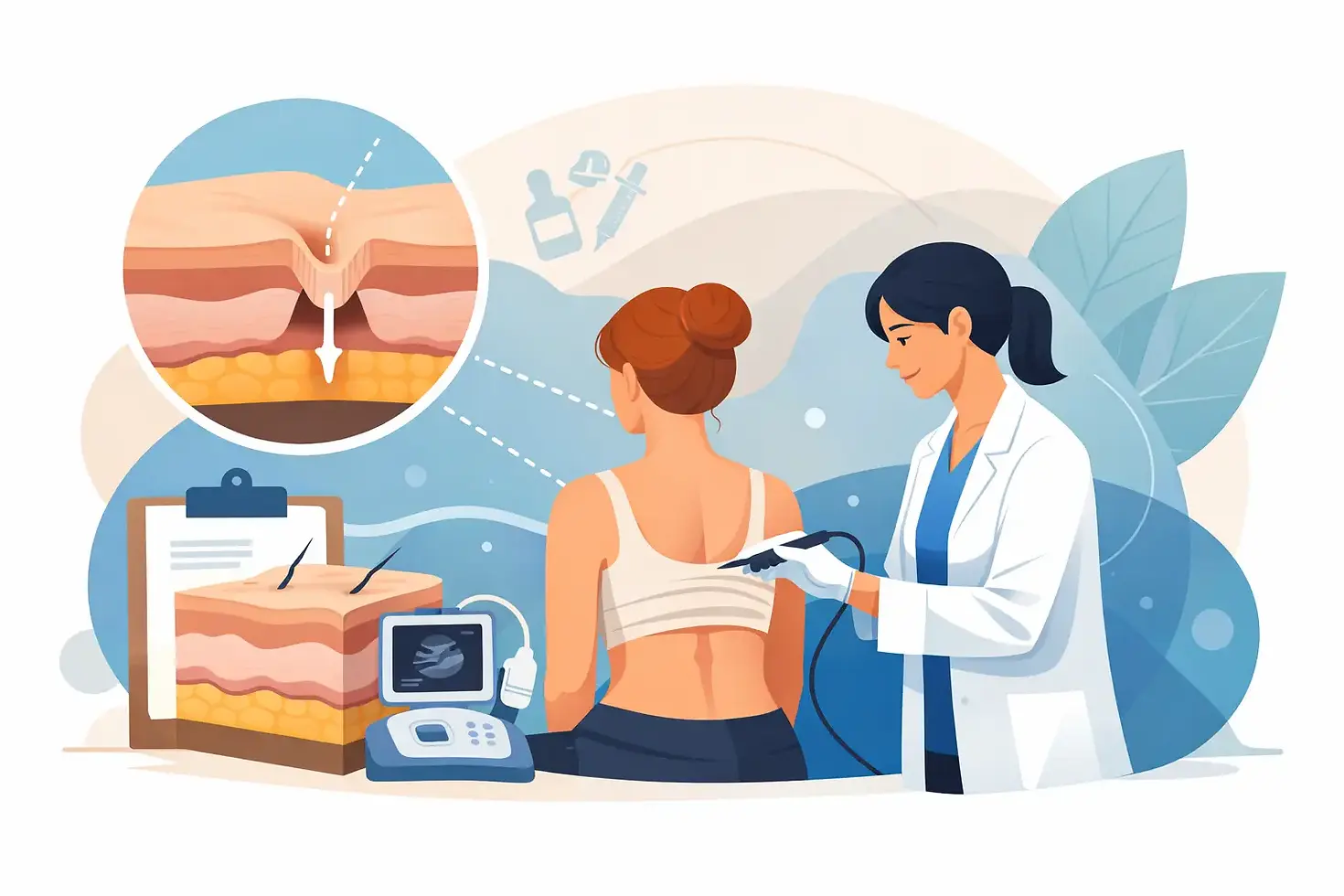
During wound healing, the body lays down collagen to repair damaged tissue. In some cases, that collagen forms firm fibrous bands between the skin and the tissue below it. Instead of gliding naturally over the underlying fat, fascia or muscle, the skin becomes anchored. This produces an indentation at rest or, more noticeably, during movement.
A tethered scar may feel hard, tight or tender. It may also cause itching, pulling, altered sensation or pain. On the face, scars tethered to muscle can distort expression. Across a joint, the abdomen, breast, neck or chest, they may limit comfortable movement, affect posture, or create a contour irregularity that clothing does not conceal easily.
Not every depressed scar is tethered, and not every tethered scar needs surgery. A broad assessment is needed to distinguish a scar that is fixed beneath the skin from one that is mainly discoloured, raised, widened, atrophic or associated with loss of volume. These features can coexist, which is why a single treatment is not always enough.
How to treat tethered scars: the specialist assessment
An effective treatment plan begins with a careful clinical examination. A consultant plastic surgeon will assess the scar at rest and in movement, palpate its depth and firmness, and determine whether it crosses an anatomical crease, joint or important structure. The original cause of the scar, wound healing history, previous operations, skin type, tendency to pigment change and symptoms all matter.
For some scars, photographs, ultrasound or review of previous operative records may help clarify the anatomy. A scar after complex surgery, radiotherapy, a major burn or trauma may need a different approach from a small acne-related adhesion. It is also essential to establish whether there is ongoing inflammation, infection, an unstable wound, recurrence of disease, or a medical issue that should be addressed before scar treatment proceeds.
The goal is not merely to make a scar less visible. It is to release harmful tension where possible, restore a more natural tissue glide, improve contour and preserve safety. In scars affecting mobility, functional improvement usually takes priority over cosmetic refinement.
Non-surgical treatments and when they help
Non-surgical treatment can be valuable, especially for early scars, mild tethering or scars with several features requiring improvement. However, a deeply anchored scar cannot reliably be freed by topical products or massage alone.
Scar massage and specialist physiotherapy may help maintain movement and soften surrounding tissues once a wound has fully healed. They are particularly relevant after burns, hand surgery and scars near joints. They should be guided by the treating team, as overly forceful massage can irritate sensitive or inflamed tissue.
Silicone gels or sheets can improve hydration and may help with immature, thickened or symptomatic scars. Pressure therapy may also be appropriate in selected burn scars. These measures do not cut the fibrous bands responsible for established tethering, but they can improve scar quality alongside other treatment.
Consultant-led laser treatment can address redness, pigmentation, surface irregularity and scar stiffness. Vascular lasers may be considered for persistent redness, while fractional ablative or non-ablative lasers can stimulate controlled remodelling of scar tissue. Laser treatment may make a scar softer and more pliable, and can complement surgical release. Its role depends on the scar’s depth, colour, maturity, skin type and location. It is not a substitute for release where a dense adhesion is mechanically pulling the skin down.
Steroid injections are sometimes used for raised or hypertrophic components, but are not a routine answer for depressed tethered scars. Inappropriately placed steroid can thin the skin or worsen indentation. This is one reason a precise diagnosis matters before any injection-based treatment.
Surgical release for deeper adhesions
When tethering is pronounced, scar release is often the most direct option. The procedure may involve carefully dividing the fibrous bands beneath the scar so that the skin can move more freely. This can be performed through a limited incision or as part of a wider scar revision, depending on the anatomy.
Subcision is one form of release used in selected depressed scars, particularly in areas such as the face. A specialist introduces an instrument beneath the skin to divide tethering bands. It can be effective, but it is not suitable for every location or scar. Important blood vessels, nerves, skin thickness, previous surgery and the depth of the adhesion must all be considered.
After release, the newly created space may need support to prevent the scar from re-adhering. Depending on the case, this may involve fat grafting, a dermal substitute, a small local tissue rearrangement or another reconstructive technique. Fat grafting can improve contour and tissue quality, but some volume is naturally reabsorbed, so more than one session may occasionally be required.
For broad, tight or complex scars, surgical scar revision may involve excising the scar and re-closing it with techniques designed to redistribute tension. Z-plasty or other local flap techniques can lengthen a contracted scar and alter its direction, which is especially useful across joints and natural skin creases. In severe burns or major trauma, reconstruction may require skin grafting, flap surgery or staged treatment.
Recovery and realistic expectations
The recovery period depends on the treatment selected. Following a minor release or subcision, bruising, swelling and tenderness can be expected for a short period. More extensive scar revision or reconstruction requires a tailored aftercare plan, including wound care, activity restrictions and sometimes physiotherapy or scar management.
Scar tissue continues to mature for many months. An early result is therefore not always the final result. Redness, firmness and temporary unevenness can occur as healing progresses. Where laser therapy is part of the plan, treatments are usually spaced to allow the skin to recover and remodel.
Every intervention carries risks. These include bleeding, infection, delayed healing, altered sensation, pigment change, contour irregularity, recurrence of tethering and the possibility of a new scar. The balance between improvement and risk is highly individual. A specialist consultation should be candid about what can reasonably be changed and what may remain visible.
Choosing the right level of expertise
A tethered scar is often a three-dimensional problem involving skin quality, scar tension, tissue loss and deeper adhesion. It deserves an assessment from a clinician able to offer both non-invasive and reconstructive options, rather than a pre-set treatment package.
At Skin Surgeon, consultant-led assessment brings plastic and reconstructive surgical judgement together with advanced therapeutic laser expertise. This is particularly relevant for scars that are functionally limiting, anatomically complex, previously treated without success, or emotionally significant to the patient.
The most useful next step is a considered consultation while the scar is stable enough to assess properly. With the right diagnosis and a carefully staged plan, many tethered scars can become softer, freer and less intrusive in daily life, even when complete erasure is neither possible nor the safest aim.


Comments